The same relationship.Not always the same experience.
Your clients may describe the same relationship in different ways. The Relational Desire Score® (RDS) helps you see both perspectives, so you can focus on what matters most.
Partners can share a life, a home, and years of history while experiencing the relationship in very different ways. Both perspectives matter, and the Relational Desire Score assessment gives you a structured way to explore what each person is experiencing.
The clinical value
Make the invisible visible.
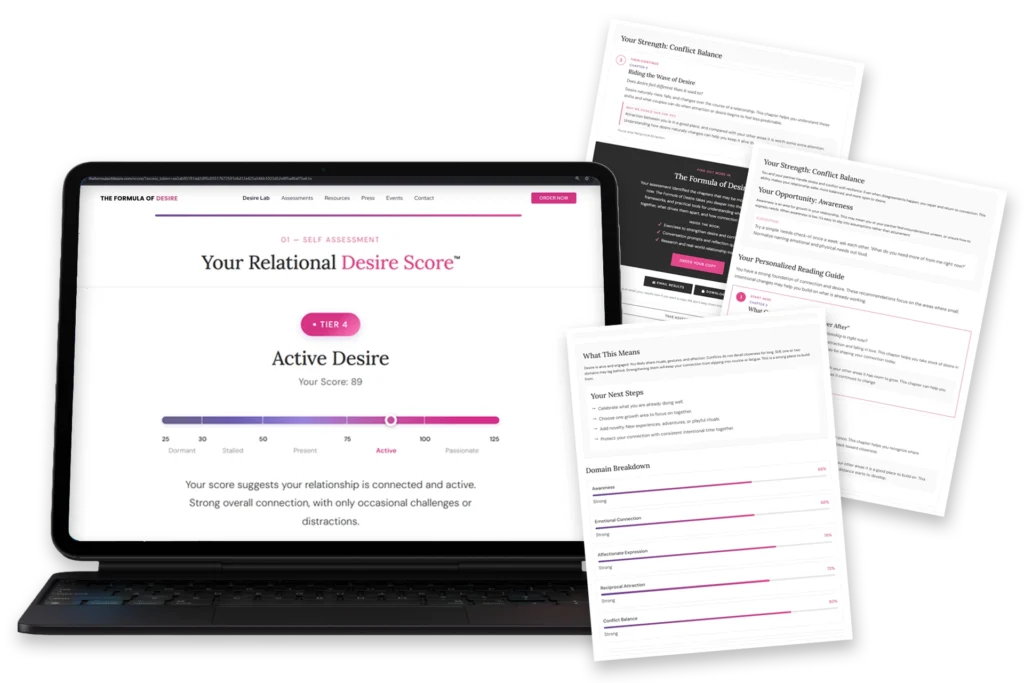
Each partner answers 25 questions independently. In about 5 minutes, they receive their Relational Desire Score, personalized results, and insights into their experience of desire and connection. Together, these results provide a starting point for exploring differences in perception, identifying areas of concern, and guiding therapeutic conversations.
Desire feels alive and mutual. Connection feels consistently present.
18
POINT
DIFFERENCE
PARTNER B
73
PRESENT
Emotionally connected. Desire shows up sometimes with a foundation to build on.
Meet your clients where they are.
Build on insights with psychoeducation, practical exercises, and worksheets designed to support focused therapeutic work, both in session and between appointments.
1
Communication
Help partners express their needs, listen with curiosity, and move beyond transactional conversations.
2
Conflict Resolution
Identify recurring patterns, navigate disagreements, and develop healthier responses to conflict.
3
Emotional Safety
Strengthen trust, emotional responsiveness, and security through guided reflection and practical exercises.
4
Physical Connection
Explore intimacy, affection, and desire while respecting each partner’s comfort and pace.
Give them something to talk about.
Share the assessment. Invite each partner to complete it individually and bring their results to the next session.
desirescore.com
A tool for the conversations you are already having.
Whether you’re working with a couple in crisis, preparing partners for marriage, or helping clients strengthen an already meaningful relationship, the RDS can provide a common language for exploring desire and connection.
Couples Therapy
Explore differing perceptions of closeness, desire, and relationship satisfaction.
Premarital Counseling
Support conversations about expectations, closeness, and shared priorities.
Sex Therapy
Consider how desire appears within the broader emotional and relational context.
Workshops or Groups
Provide a reflective exercise to better understand their relationships.
Turning relationship insights into focused, meaningful conversations.
The Relational Desire Score® brings often-unspoken relationship dynamics into focus, revealing the connection one partner experiences, the distance the other perceives, and the differences in how each understands their relationship.
Understand each partner’s experience of desire, connection, and relationship dynamics.
Identify Key Patterns
Highlight strengths, areas of growth, and differences in how partners perceive their relationship.
Guide Conversations
Explore what matters most and determine where additional support may be helpful.
Beyond the assessment
A clearer picture of where couples stand.
The Formula of Desire includes more than 20 exercises, assessments, and reflection activities designed to support communication, conflict resolution, emotional safety, and physical connection.
Your copy also provides access to the online Desire Lab, featuring 12 additional exercises and assessments, downloadable worksheets, and practical resources for use in sessions or between appointments.
We use cookies to analyze website traffic and improve your experience. Learn more
Desire Stages Explained
What Desire Feels Like Across Stages
Understanding your Relational Desire Score™
1
Dormant Desire (25–29)
You may feel alone, even when you’re together. Intimacy is minimal, and disconnection may be longstanding or difficult to overcome.
2
Stalled Desire (30–49)
You care about each other, but something is missing. Conversations tend to be practical, and physical affection may be routine or entirely absent.
3
Present Desire (50–74)
The connection exists but may feel inconsistent. Intimacy requires effort and may be more impacted by outside stressors.
4
Active Desire (75–99)
You feel connected, and desire remains strong, event when stress or life demands occasionally disrupt closeness. Repairs are effective, and the connection is beting maintained.
5
Passionate Desire (100–125)
You feel wanted, emotionally safe, and physically close. Intimacy is natural, mutual, and fulfilling.
Your relationship stage isn’t fixed.
Relationships can move between desire stages as connection, stress, intimacy, and circumstances change. Your stage reflects where your relationship is right now.