About The Book

Inside The Formula of Desire

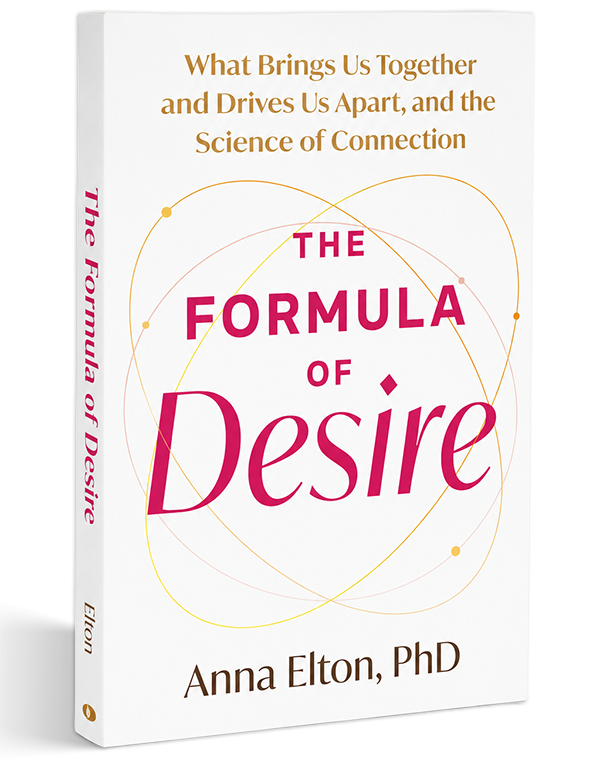
What Brings Us Together and Drives Us Apart, and the Science of Connection

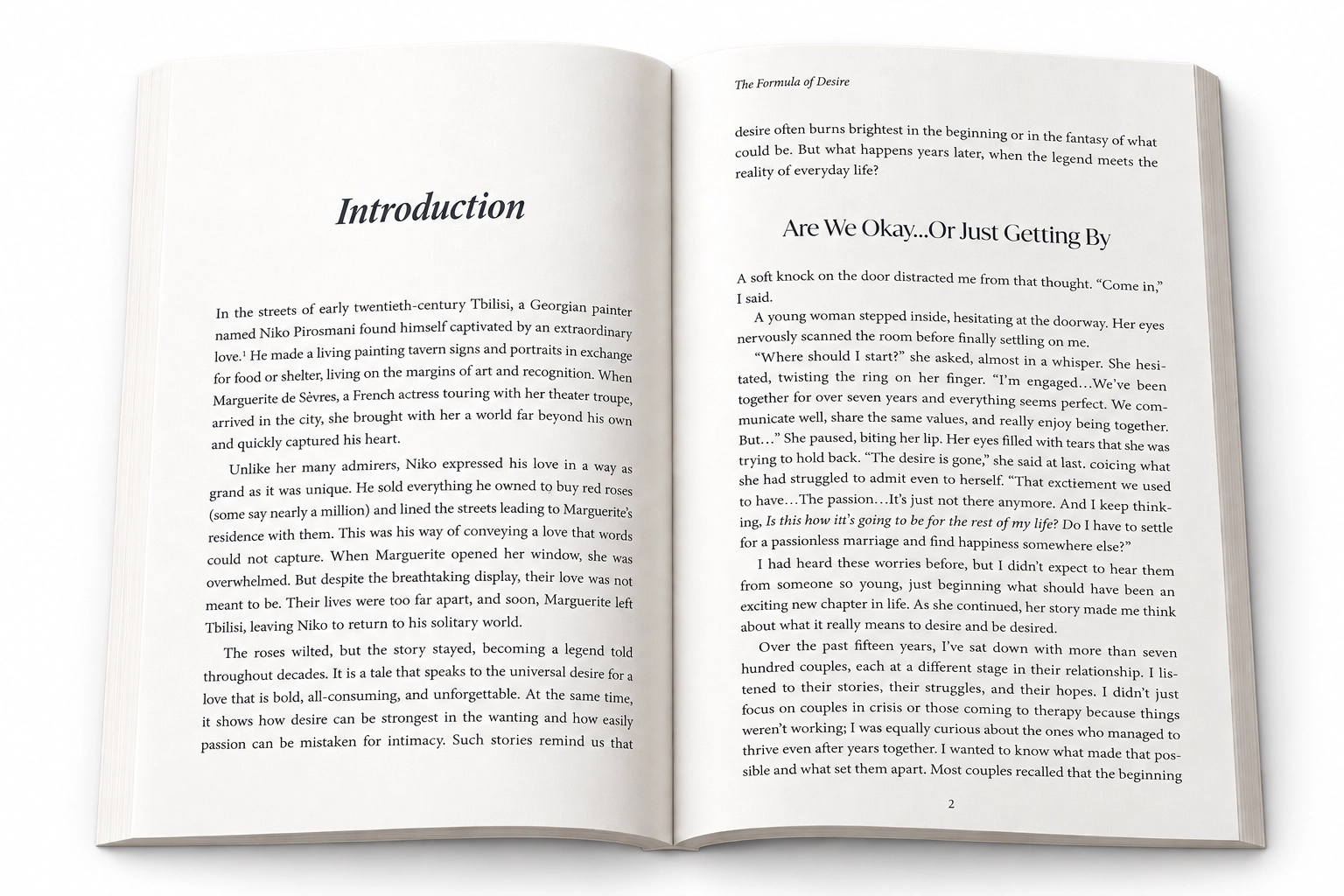
Desire often burns brightest in the beginning. This book is about what happens after: why attraction fades, how intimacy evolves, and what it really takes to stay close over time.

Drawing on relationship research and more than a decade of clinical work with couples, Anna Elton offers a new way to see, measure, and strengthen the connection that brought you together.

Author
Anna Elton, PhD
Publisher
New Harbinger
Published
August 2026
Format
Paperback, eBook, Audio
Pages
264
ISBN
978-1648488788

Who It’s For

For everyone
no matter where
they are in their relationship.

Long-term couples

You love each other, but the spontaneous desire has faded and you’re wondering whether this is just how it goes now.

Newer couples

You don’t need to be in a relationship right now but you want to understand how desire works before it starts to shift.

Readers on their own

You don’t need your partner on board to start seeing your relationship differently.

Therapists & clinicians

You’re looking for research-informed frameworks to use in your work with individuals and couples.

Read a sample

Start with the first chapters.

This sample includes the Preface, Introduction, and first two chapters of Part 1: Getting to Know Desire.

Chapter 1: Life, Love, and Desire

How desire differs from love and attachment, why emotional climate matters, and how everyday life can reshape connection over time.

Chapter 2: Desire by Design

How attraction is shaped by chemistry, context, memory, perception, and the signals we may misread.

What readers are saying

“

An informative and fascinating read from start to finish.”

– MIDWEST BOOK REVIEW

“

“The Formula of Desire is a fantastic book. I deeply enjoy self-help books and have read many relationship books over the years, but I genuinely believe this is one of the best I’ve ever encountered.”

Laura (goodreads)

“

“As a Master’s in Social Work student, I was immediately drawn to The Formula of Desire… Even from the opening chapters, it’s clear this is much more than a typical relationship self-help book.”

Alisha (goodreads)

What’s Inside

Three groundbreaking frameworks

Each one gives you a new lens on your relationship, supported by dozens of practical tools and exercises throughout the chapters.

The Wave of Desire

Why attraction changes over time.

Desire isn’t static. It’s a wave. It moves through phases shaped by biology, connection, life stress, and the stories we tell ourselves about our relationships.

The Three Selves

The Me, We, and Us

Balance who you are as an Individual, as a Couple, and as Family, the foundation for sustainable intimacy and connection.

The Relationship Shift

How relationships change over time.

Relationships don’t collapse overnight. They move between emotional zones shaped by stress, meaning, memory, and unmet needs.

About the Author

Anna Elton

PhD, Licensed Marriage & Family Therpist, Certified Sex Therapist

Anna Elton is a licensed marriage and family therapist and certified sex therapist who has spent more than a decade helping couples understand what keeps desire alive and what pulls partners apart.

Her work with more than 700 couples shaped the frameworks in The Formula of Desire and led to the Relational Desire Score, a tool that turns a relationship’s patterns into something couples can see and work with.

Published By

The Formula of Desire: What Brings Us Together and Drives Us Apart and The Science Behind It is published by New Harbinger Publications, a leading publisher of evidence-based self-help and psychology books.

Not sure where to start? Take the Relational Desire Score™ Assessment

See where desire stands in your relationship before you read.

02 — FRAMEWORK

Wave of Desire

The question is, do you ride the wave or drift apart?

Desire isn’t static—it’s a wave that moves through phases shaped by biology, connection, life stress, and the stories we tell ourselves. Every couple rides this wave. Some fall off. Some paddle back. But the ones who thrive learn to ride it together.

Do you ride it together?

THE FIVE PHASES

– Attraction: Electric spark and butterflies

– Commitment: Steady connection and shared life

– Stagnation: When intimacy slides down the list

– Rediscovery: The turning point back up

– Re-attraction: Falling for each other again

Stagnation isn’t failure—it’s a natural phase every couple encounters. The difference is whether you notice it and choose to ride the wave back up together.

Learn to navigate all five phases in Chapter 9.

03 — FRAMEWORK

The Three Selves

Me, We, Us

Lasting intimacy requires balance across three fundamental dimensions of identity. You need space to be yourself (Me), connection as a couple (We), and belonging to something larger (Us). When any dimension is neglected, the whole system becomes unstable.

Are all three in balance?

The Three Dimensions

Me: Individual identity, autonomy, personal growth, and self-expression

We: Couple identity, shared values, partnership, and intimate connection

Us: Family bonds, community ties, legacy, and collective belonging

Many couples over-invest in “Us” at the expense of “We” and wonder why they feel less connected—or focus too much on “Me” and lose “We” entirely. Sustainable connection requires dynamic balance across all three dimensions.

This framework is explored with dedicated focus in Chapter 5.

02 — FRAMEWORK

The Relationship Shift Model

Negative. Neutral. Positive.

Relationships are not static, they shift and rarely break all at once. Over time, couples move through three emotional zones — the Positive Zone, where warmth and attraction reinforce connection; the Neutral Zone, where stability replaces intensity; and the Negative Zone, where conflict and resentment begin to dominate.

When emotional tone changes, perception changes. The same behaviors can feel supportive in one zone and irritating in another. What determines the shift is not a single argument, but the overall emotional climate.

Where is your relationship right now?

THE THREE ZONES

– Positive Zone: Warmth, responsiveness, shared meaning, mutual desire

– Neutral Zone: Functional partnership, low conflict but low intimacy

– Negative Zone: Criticism, defensiveness, repeated conflict loops

Many couples believe they are “fine” because conflict has decreased. In reality, they may have shifted into neutrality. Sustainable connection requires awareness of the shift and intentional movement back toward positivity.

This model is explored in depth in Chapter 4.