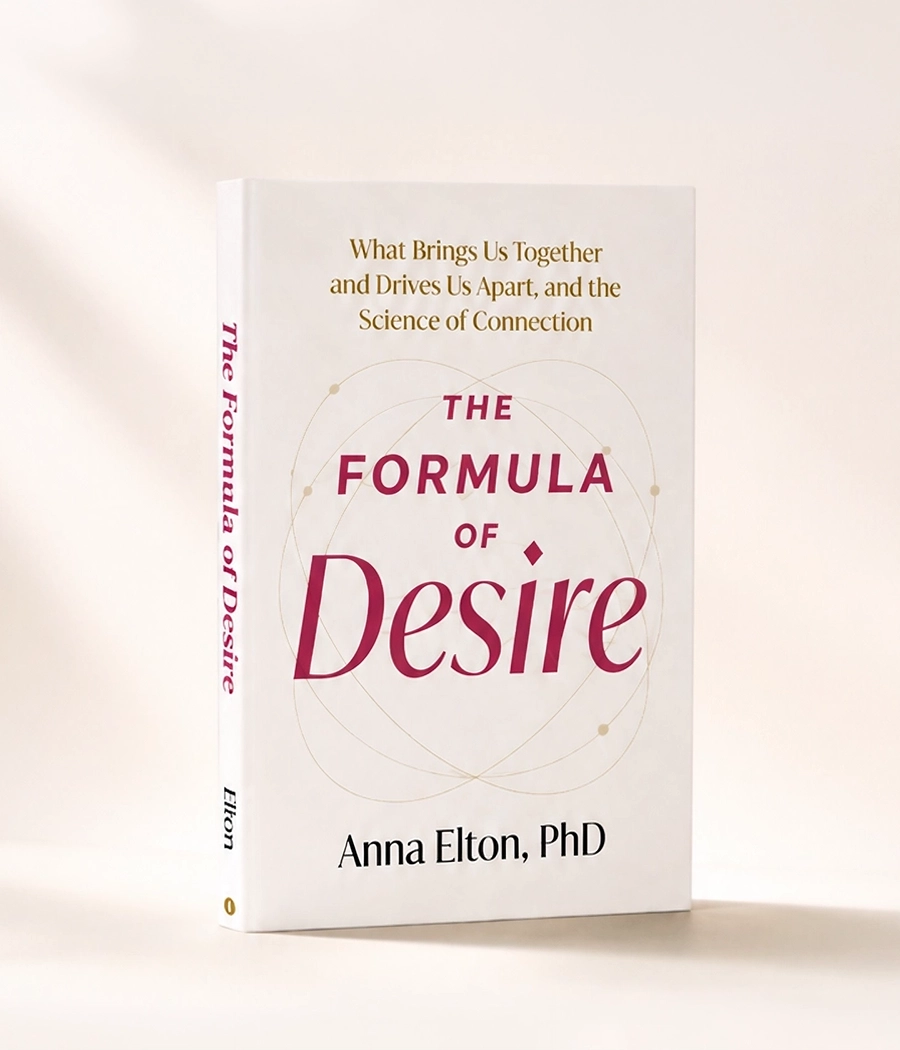
New Book

Discover what pulls us close, pushes us apart, and what it takes to stay connected throughout every phase of love.

Written by clinical sexologist Dr. Anna Elton, the book blends research, real stories, and therapeutic insight.

Pre-Order Today

USA

Canada

Kindle

Available: August 1, 2026

About the Book

Part science.

part story.

Part guide.

The Formula of Desire explores the psychology of attraction, attachment, and disconnection, revealing how desire evolves over time and offers a new way to see, measure, and strengthen the connection that brought you together.

Through evidence-based frameworks and real-world application, this book helps you understand what keeps desire alive, what distances us from our partners, and how to sustain intimacy through every phase of love.

01 — Assessment

Get Your

Desire Score

Before You Read the Book.

Your relationship already has a pattern.

This gives you the numbers behind it.

Developed from over a decade of clinical practice and insights from 700+ couples, the Relational Desire Score measures connection across six core dimensions including emotional safety, intimacy, attraction, alignment, conflict patterns, and stress load.

This is not a personality quiz. It is the diagnostic framework The Formula of Desire is built on.

In under 10 minutes, you’ll see where desire is thriving, where it is quietly eroding, and what is shaping the emotional climate of your relationship right now.

What’s Inside

Groundbreaking Frameworks +

These three core frameworks anchor the book along with dozens of practical tools, exercises, and insights to help you navigate every phase of desire

01 — Framework

Wave of Desire

Understand how desire naturally flows through phases and learn to navigate the ebbs and flows together.

Wave of Desire Play

02 — Framework

The Three Selves

Balance who you are as Me, We, and Us, the foundation for sustainable intimacy and connection.

The Three Selves Together Dark Background Play

03 — Framework

The Relationship Shift

Recognize the zones your relationship moves through and what it takes to shift toward where you want to be.

Relationship Shift Model Background

Published By

The Formula of Desire: What Brings Us Together and Drives Us Apart and The Science Behind It is published by New Harbinger Publications, a leading publisher of evidence-based self-help and psychology books.

02 — FRAMEWORK

Wave of Desire

The question is, do you ride the wave or drift apart?

Desire isn’t static—it’s a wave that moves through phases shaped by biology, connection, life stress, and the stories we tell ourselves. Every couple rides this wave. Some fall off. Some paddle back. But the ones who thrive learn to ride it together.

Do you ride it together?

THE FIVE PHASES

– Attraction: Electric spark and butterflies

– Commitment: Steady connection and shared life

– Stagnation: When intimacy slides down the list

– Rediscovery: The turning point back up

– Re-attraction: Falling for each other again

Stagnation isn’t failure—it’s a natural phase every couple encounters. The difference is whether you notice it and choose to ride the wave back up together.

Learn to navigate all five phases in Chapter 9.

03 — FRAMEWORK

The Three Selves

Me, We, Us

Lasting intimacy requires balance across three fundamental dimensions of identity. You need space to be yourself (Me), connection as a couple (We), and belonging to something larger (Us). When any dimension is neglected, the whole system becomes unstable.

Are all three in balance?

The Three Dimensions

Me: Individual identity, autonomy, personal growth, and self-expression

We: Couple identity, shared values, partnership, and intimate connection

Us: Family bonds, community ties, legacy, and collective belonging

Many couples over-invest in “Us” at the expense of “We” and wonder why they feel less connected—or focus too much on “Me” and lose “We” entirely. Sustainable connection requires dynamic balance across all three dimensions.

This framework is explored with dedicated focus in Chapter 5.

02 — FRAMEWORK

The Relationship Shift Model

Negative. Neutral. Positive.

Relationships are not static, they shift and rarely break all at once. Over time, couples move through three emotional zones — the Positive Zone, where warmth and attraction reinforce connection; the Neutral Zone, where stability replaces intensity; and the Negative Zone, where conflict and resentment begin to dominate.

When emotional tone changes, perception changes. The same behaviors can feel supportive in one zone and irritating in another. What determines the shift is not a single argument, but the overall emotional climate.

Where is your relationship right now?

THE THREE ZONES

– Positive Zone: Warmth, responsiveness, shared meaning, mutual desire

– Neutral Zone: Functional partnership, low conflict but low intimacy

– Negative Zone: Criticism, defensiveness, repeated conflict loops

Many couples believe they are “fine” because conflict has decreased. In reality, they may have shifted into neutrality. Sustainable connection requires awareness of the shift and intentional movement back toward positivity.

This model is explored in depth in Chapter 4.